
krusch-coding-harness
dev.krusch/krusch-coding-harness
Two-phase commit coding harness that stages diffs, runs sandboxed tests, and applies atomically.
Documentation
KRUSCH CODING HARNESS (v0.2.0)
PostgreSQL-backed coding harness (krusch-coding-harness) that stages diffs, runs sandboxed tests, and only then writes to disk. Models are ephemeral workers.








Core Thesis: Models are ephemeral compute; PostgreSQL is the brain. Keep workflow, context, tests, and approvals consistent while making models interchangeable. Deterministic gates do not guarantee that a model's plan is semantically right; they bound blast radius, block repeatable defect classes, and guarantee clean rollback when verification fails.
⚡ 5-Minute External Engineer Verification & Recorded 5-Step Demo
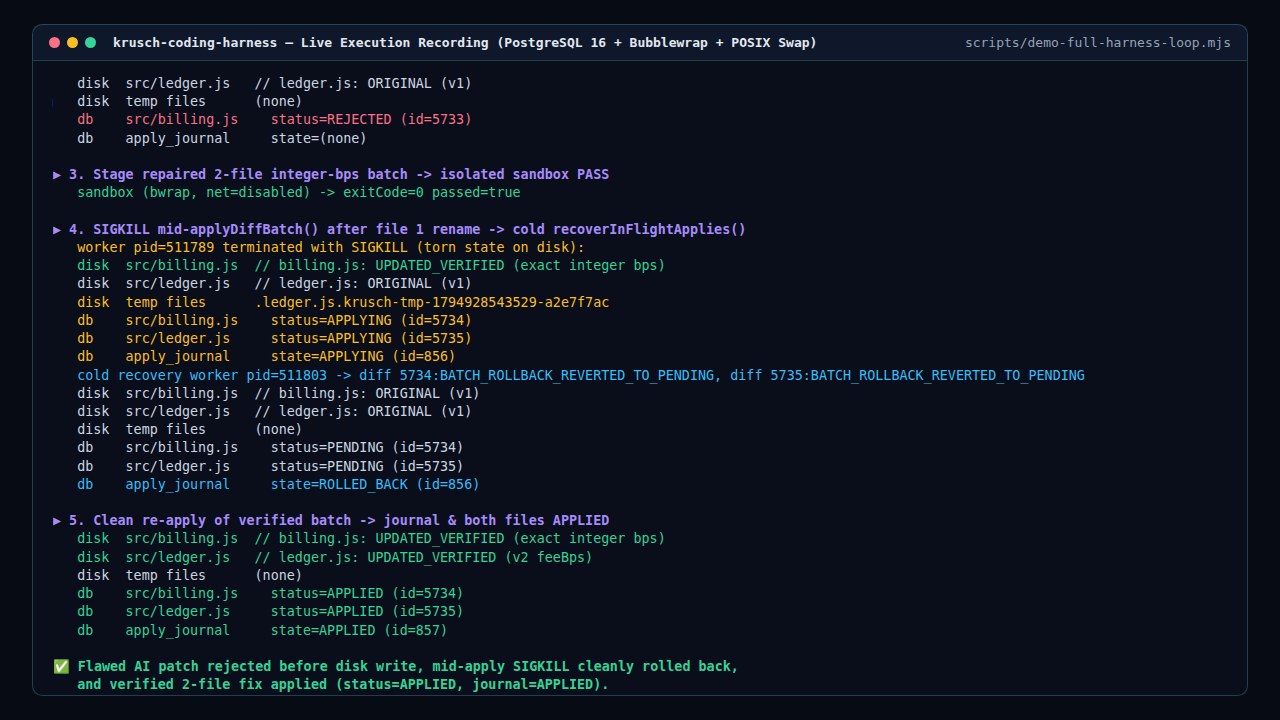
▶️ Watch 20s Recorded Live Execution (
720pMP4) · Raw Terminal Output (.txt) · Source (scripts/demo-full-harness-loop.mjs) · 15sSIGKILL-Only ClipReal execution against
PostgreSQL 16andBubblewrap(bwrap --unshare-net) with zero mocks: (1) stages a flawed AI billing patch inkrusch_staged_diffswithout touching disk, (2) fails isolated sandbox tests (exitCode=1) and rejects the diff (status=REJECTED), (3) stages and sandbox-verifies the repaired 2-file integer-cent fix (exitCode=0), (4) killsapplyDiffBatch()mid-apply withSIGKILLafter file 1 is renamed and rolls back torn state via cold-workerrecoverInFlightApplies(), and (5) cleanly applies both files (status=APPLIED).
Agent-Assisted Setup
Ask your coding agent (Claude Code, Codex, Cursor, Windsurf, or Antigravity):
Read https://raw.githubusercontent.com/kruschdev/krusch-coding-harness/main/INSTALL.md and set up krusch-coding-harness on this machine.
Path A: Zero-Postgres, Zero-API-Key Verification (<30 seconds)
Runs in-process using built-in PGlite and deterministic fixtures (no Docker, no database server, no API keys):
git clone https://github.com/kruschdev/krusch-coding-harness.git
cd krusch-coding-harness
npm ci

# 1. Run 52 fast unit tests (AST indexer, router gate, Slack HITL, cost kill-switch, SSRF fallback, policy floor)
npm run test:unit

# 2. Replay all 100 golden trajectories across 10 failure categories
npm run eval:trajectories

# 3. Verify TypeScript .d.ts declarations and run a complete ephemeral PGlite task
npm run typecheck
./bin/krusch-coding-harness.js run "Verify arithmetic module fix" --mock --ephemeral --auto-approve
Path B: Full PostgreSQL 16 + Bubblewrap 5-Step Crash-Recovery Loop (<3 minutes)
# 1. Start PostgreSQL 16 (defaults to postgresql://postgres:postgres@localhost:5432/krusch)
docker compose up -d

# 2. Apply all 11 SQL schema & row-lock invariant migrations
npm run migrate

# 3. Run all 118 unit, ephemeral, and PostgreSQL integration tests (includes real SIGKILL crash test)
npm test

# 4. Run the live 5-step stage -> fail -> repair -> SIGKILL recovery -> apply loop
node scripts/demo-full-harness-loop.mjs
When simpler suffices: For a single interactive developer session, an isolated
git worktree, staged diff, and sandboxed test run (the zero-Docker SQLite default inkrusch-stack) achieves practical safety with less operational surface. PostgreSQL write-ahead journaling targets unattended background daemons and multi-worker queues where crash recovery, file-lease concurrency, and durable audit state justify a database.
What You Get If You Only Clone krusch-coding-harness
When you clone this repository, you get a fully functional, self-contained headless execution engine with zero external cloud API dependencies:
┌────────────────────────────────────────────────────────────────────────┐
│                   IN-TREE CAPABILITIES IN THIS REPO                    │
├────────────────────────────────────────────────────────────────────────┤
│  ✓ Pre-Commit Staging Engine: SHA-256 content-addressed blobs         │
│  ✓ PostgreSQL FSM: Row-locked phase transitions (INIT ➔ COMMITTED)     │
│  ✓ Isolated VERIFY Sandbox: Bubblewrap (bwrap) / process jail          │
│  ✓ Capability Allowlist: Test runners only; freeform shells blocked   │
│  ✓ "2PC" Apply Journal: crash-recoverable fsync + per-file rename     │
│  ✓ In-Memory Postgres: Zero-setup local evaluation via PGlite          │
│  ✓ AST Symbol Indexer: JS, TS, Python, Go, Rust structural symbols     │
│  ✓ Async HITL Slack Gate: 72h lease + fail-closed HMAC-SHA256 resume   │
│  ✓ $0.50 Cost Kill-Switch: Loop-depth & local Ollama fallback router   │
│  ✓ API-to-Browser Fallback: SSRF-hardened REST ➔ GUI failover          │
│  ✓ Golden DAG CI Gate: 100-trajectory PR blocker across 10 categories  │
│  ✓ OpenTelemetry Spans & Cost Ledger: Audit trace JSON per task       │
│  ✓ Unified Control Plane: Doctor, :3778 HTTP Bridge & 7-Tool MCP       │
└────────────────────────────────────────────────────────────────────────┘
[!NOTE] Decoupled Architecture: Sibling packages (
krusch-pre-router,krusch-cascade-router,krusch-context-mcp,krusch-git) are dynamically resolved adapters. This repository includes its own in-tree regex heuristic gate and deterministic mock adapter that run out of the box with zero external git dependencies or cloud keys.
Architecture Diagram
flowchart TD
    subgraph ControlPlane ["Unified Headless Control Plane"]
        CLI["CLI (bin/krusch-coding-harness.js | bin/krusch.js: doctor / ci / serve / bench)"]
        Bridge["HTTP Control Bridge (127.0.0.1:3778)"]
        MCP["MCP Server (stdio - 7 tools)"]
    end

    subgraph Workflow ["Workflow & Safety Engine"]
        FSM["KruschStateMachine (Row-Locked FSM)"]
        Guard["TrajectoryGuard (Loop & Escalation)"]
        Classifier["ModularRSI (Failure Attribution)"]
    end

    subgraph StorageEngine ["PostgreSQL Brain (ACID State)"]
        Tasks["krusch_tasks (Budgets & Revisit Caps)"]
        Blobs["krusch_blobs (Content-Addressed Deduplication)"]
        Diffs["krusch_staged_diffs (Leases & Pre-Commit Hashes)"]
        Journal["krusch_apply_journal (2PC State & Preimages)"]
        Runs["krusch_verification_runs (Replay Tokens & Envs)"]
    end

    subgraph Sandbox ["Isolated VERIFY Sandbox"]
        Bwrap["Bubblewrap (bwrap) / Process Jail"]
        BaseRO["Base Tree (Read-Only Bind)"]
        Overlay["Overlay / Staged Tree Copy"]
        Allowlist["Capability Allowlist (Test Runners Only)"]
        Bwrap --> BaseRO
        Bwrap --> Overlay
        Bwrap --> Allowlist
    end

    subgraph Disk ["Physical Working Tree"]
        WorkingTree["Physical Disk Files"]
    end

    CLI --> FSM
    MCP --> FSM
    FSM --> StorageEngine
    FSM --> Sandbox
    Sandbox -->|Record Results & Exit Code| Runs
    StorageEngine -->|Verified & Approved: 2PC Crash-Recoverable Apply| WorkingTree
🧭 System Principles & Invariants
- State Lives in PostgreSQL: Primary task state, turns, events, and proposed file edits never live in transient scratchpads. All state persists to relational tables.
- Pre-Commit Staging Invariant: File edits generated by models are staged into
krusch_staged_diffswith SHA-256 validation. Physical disk files are never touched until tests pass and approval is granted. - Hard Sandbox Isolation: Verification does not run unconstrained on the user's checkout. It executes in an unprivileged Bubblewrap container (or process jail) with a read-only base tree, network isolation (
--unshare-net), scrubbed credentials (cleanEnv), memory/time limits, capability allowlisting, and process group termination. - Actionable Failure Attribution: Failures are classified into specific modules (
ContextManagement,ToolUse,ObservationManagement,AgentLoop) usingKruschFailureClassifierrather than blind re-prompting. - Storage-Engine-Grade Apply Journal: the 2PC apply journal (my name for a journaled, crash-recoverable multi-file apply protocol) provides per-file atomic replacement, upfront drift detection, and idempotent crash recovery. It does not make a multi-file batch atomically visible: other processes can observe a partly-applied batch until it completes or is rolled back.
📊 Empirical Benchmarks (95/95 Clean-Room SHA-256 Gates, Self-Run in Lab)
Evaluation Provenance & Third-Party Reproduction Status: Every benchmark below uses a public external dataset run in my lab, with
49SHA-256-pinned raw audit log bundles (64files) across335,000+queries/traces and14external suites published openly on Hugging Face atkrush420/sovereign-g4-benchmarksand interactively atkrush420/sovereign-router-arena(including the maintainer-mergedRouteWorks/RouterArenaPR #169 receipt bundle onmain @ 844e93b). No outside party has yet re-run these harness evaluations; reproduction issues and independent verification attempts are welcome.
1. Aider Polyglot (225 / 225 Multi-Language Coding Tasks)
Evaluated hermetically across all 225 official Aider-AI/polyglot-benchmark tasks (cpp, go, java, javascript, python, rust with mandatory upstream test un-skipping: --include-ignored, xtest → test, -DEXERCISM_RUN_ALL_TESTS=1, @Disabled stripped, pristine test-hash verification, and clean-workspace .meta/.docs/test exclusion) pairing open-weights gpt-oss:120b with isolated bwrap sandbox test execution + evaluateVerifyOnStop:
| Track | Exercises | 1-Shot Pass@1 | krusch-coding-harness 2PC Verify-on-Stop Pass@2 | Tasks Self-Healed | Multiplier |
|---|---|---|---|---|---|
Overall (Aider Polyglot) | 225 | 19.56% (44/225) | 51.56% (116/225) | +72 | 2.64x (+32.00 pp) |
Rust (cargo test -- --include-ignored) | 30 | 36.67% (11/30) | 66.67% (20/30) | +9 | 1.82x |
JavaScript (npm test, xtest unskipped) | 49 | 18.37% (9/49) | 59.18% (29/49) | +20 | 3.22x |
Go (go test ./...) | 39 | 25.64% (10/39) | 53.85% (21/39) | +11 | 2.10x |
Python (pytest) | 34 | 14.71% (5/34) | 47.06% (16/34) | +11 | 3.20x |
C++ (cmake -DEXERCISM_RUN_ALL_TESTS=1) | 26 | 3.85% (1/26) | 42.31% (11/26) | +10 | 11.00x |
Java (./gradlew test, @Disabled stripped) | 47 | 17.02% (8/47) | 40.43% (19/47) | +11 | 2.38x |
Attribution: The
19.56% -> 51.56%lift (+72tasks) comes from isolated sandbox test execution, compiler/test error feedback, and bounded repair retries (Pass@2Verify-on-Stop), reaching parity with published single-modelClaude 3.5 Sonnet(51.6%) reference scores at$0external API cost with0truncated diffs committed.
2. BIRD-SQL Mini-Dev (500 / 500 Dirty Enterprise SQLite Queries × 11 Databases)
Evaluated across all 500 official birdsql/bird_mini_dev queries (11 SQLite databases, runtime JS Proxy blocking .SQL / .gold_sql, read-only DatabaseSync(..., { readOnly: true }) schema/FK/cell-value grounding, createKruschPolicyFloor DDL/DML blocklist, and evaluateVerifyOnStop execution-error / empty-set self-healing on gpt-oss:120b):
| Strategy | Queries | Execution Accuracy (EX) | R-VES | Valid Executable SQL | Verify-on-Stop Healed |
|---|---|---|---|---|---|
raw_ddl_oneshot (Raw CREATE TABLE DDL Only) | 500 | 26.00% (130/500) | 24.15% | 97.80% | 0 |
schema_value_grounded_pass1 (FK + Sample Cell Grounded) | 500 | 37.60% (188/500) | 33.30% | 99.40% | 0 |
krusch_2pc_sql_heal (krusch-coding-harness 2PC) | 500 | 40.20% (201/500, 1.55x) | 35.75% | 100.00% (500/500) | +13 (45 retries = 0.09/q) |
Lifts
toxicology5.00x(12.50%→62.50%),moderatedifficulty from32.40%→50.00%, andchallengingdifficulty from27.87%→39.35%while eliminating100%of invalid/syntax-errored SQL.
3. ETH SpyLab AgentDojo v1.2.2 (1,046 / 1,046 Indirect Prompt-Injection Episodes)
Evaluated across all 1,046 official ethz-spylab/agentdojo (v1.2.2) episodes (97 benign user tasks + 949 ImportantInstructionsAttack adversarial episodes across workspace, banking, slack, and travel on gpt-oss:120b, zero hardcoded benchmark tokens):
| Defense Strategy | Benign Utility (n=97) | Attacked Utility (n=949) | Targeted Attack Success Rate (ASR ↓) | Defense Rate (↑) | Policy-Floor Blocks |
|---|---|---|---|---|---|
raw_unprotected_agent (No Guard) | 61.86% (60/97) | 55.32% | 19.28% (183/949 hijacked) | 80.72% | 0 |
spotlighting_delimited_only (<UNTRUSTED_CONTENT> Only) | 69.07% (67/97) | 54.58% | 14.86% (141/949 hijacked) | 85.14% | 0 |
krusch_sovereign_defense (createKruschPolicyFloor + Taint Guard) | 61.86% (0.00 pp loss) | 49.95% | 0.00% (0/949 hijacked) | 100.00% | 83 |
Scope Qualification:
0/949hijacked (0.00%ASR across1,046episodes) is a benchmark-specific finding under active import-frozenObject.freezepolicy floors, network-disabledbwrap --unshare-netsandboxes, and taint guards, not a claim of universal prompt-injection immunity.
4. Official DolphinBench & Generalized 2PC Tool-Action Harness (28 Runs, 16,800 openai/gpt-5.6-sol Traces, 6 Families)
Evaluated across 28 official 600-task DolphinBench runs (16,800 openai/gpt-5.6-sol traces across 6 model families; 28/28 passing dolphinbench.submission.validate, 8 flagship .zip archives uploaded & status: "queued" on dolphinbench.ai awaiting leaderboard acceptance; full paper: Return on Memory):
Configuration (Checkpoint + Tool Loop) | Official gpt-5.6-sol Score | Cost | Status & Key Result |
|---|---|---|---|
Gemini 4 Argon (Low, Std. Harness) | 91.17% (547/600) | $24.54 | Uploaded dolphinbench.ai submission UUID c047b063 (status: "queued"; Argon Low + Grounded v0.3 = 90.67% [544/600 @ $30.54] in self-run clean-room eval) |
Model-Matched: GPT 5.6 Luna (High + Grounded / Std.) | 81.50% (489) / 81.33% (488) | $1.35 | +10.83 pp (+65 tasks) higher & 71.1x cheaper than published 70.67% GPT 5.6 Luna + Mem0 ($96.21); Luna (Low) = 76.67% (460/600 @ $1.10) |
Open-Weights: Gemma 4 31B (Wave-6 + Grounded / Stock) | 57.33% (344) / 54.17% (325) | $0.00 | Highest open-weights score in self-run 28-run eval (57.33% krush420/gemma4-31b-sre-lora); stock 54.17% uploaded & queued (UUID 288671ad) |
Qwen3-Coder-30B-A3B Wave-4 (Std. Harness vs. + 2PC) | 42.67% / 42.00% | $0.00 | Std. Harness = 256/600; + 2PC = 252/600, cutting duplicate MCP calls by -95.2% (42 -> 2) and lifting 2-pass 30B Oracle@2 to 50.33% (302/600) |
Ensembles (Oracle@28 Global / Oracle@17 $0.00 Open-Weights) | 98.33% / 83.17% | N/A / $0.00 | Oracle@28 = 98.33% (590/600, <= 1.67% retrieval miss) · $0.00 Open-Weights Oracle@17 = 83.17% (499/600) |
🔒 The Safety Story: Hard Sandbox Isolation
Physical disk protection is meaningless if the verification step can escape and mutate the tree or leak credentials. Krusch enforces hard boundaries:
- Bubblewrap Unprivileged Container: Mounts the host and project root read-only (
--ro-bind / /), isolates the network (--unshare-net), isolates process namespaces (--unshare-pid), and overlays the staged modifications. - Process Jail Fallback: On environments where
bwrapis unavailable, executes in a detached process group and kills the entire group (SIGKILL) on timeout or failure. - Capability Allowlist:
run_commandand verification commands are restricted to recognized test runners (npm test,node --test,pytest,cargo test,go test,vitest,jest). Destructive shell patterns (curl,wget,rm -rf, interactive shells) are rejected before execution. - Durable Replay Token: Every run records the sandbox type, environment snapshot, file manifest, command, exit code, and a deterministic SHA-256 replay token in
krusch_verification_runs.
💾 Storage Engine & Apply Journal
Terminology: what "2PC" means here. In this project, "2PC" is the name of a journaled, crash-recoverable multi-file apply protocol: PostgreSQL records durable write-ahead intent (
krusch_apply_journal,krusch_staged_diffs.status = 'APPLYING'), each file is written to a temporary sibling,fsync'd, and swapped in with a POSIX atomicrename, andrecoverInFlightApplies()repairs any interrupted batch on restart. It is not classic distributed two-phase commit with transactional participants. Each individual file replacement is atomic, but a multi-file batch is not atomically visible: another process can observe a partly-applied batch until it completes or recovery rolls it back. Runnode scripts/demo-full-harness-loop.mjs(ornode scripts/demo-crash-recovery.mjs) to see aSIGKILLmid-apply and cold-worker recovery.
The apply engine treats disk writes like database transactions:
[ PENDING ] ──(Verification Passed & Approved)──> [ APPLYING ] ──(fsync & rename)──> [ APPLIED ]
     │                                                    │
     │                                            (Crash Detected)
     │                                                    │
     └─────────────(Idempotent Crash Recovery)────────────┘
- Content-Addressed Blobs: Identical file contents across tasks and turns are deduplicated in
krusch_blobs. - Upfront Drift Detection: Before any file is modified, disk hashes are compared to original base preimages. If working-tree drift is detected, the entire batch aborts with zero disk writes.
- Crash-Recoverable Multi-File Apply: Files are written to temporary siblings,
fsync'd to storage media, and renamed. If a crash occurs mid-batch, startup recovery inspectskrusch_apply_journal, restores renamed files to base preimages, and removes orphaned temporary files. - Idempotent Recovery: Recovery operations can run multiple times without side effects.
🎛️ Operator CLI & FSM Controls
krusch-coding-harness provides operator commands to unstick, audit, and manage tasks. CLI commands support krusch-coding-harness as well as backwards-compatible aliases krusch-harness and krusch:
# Check 3-Tier ecosystem health & dependencies
krusch-coding-harness doctor

# Start headless HTTP Control Bridge daemon (:3778)
krusch-coding-harness serve

# Run automated Headless CI gate
krusch-coding-harness ci

# Run 2PC Crash-Recoverable Apply & Verification Latency Benchmark
krusch-coding-harness bench

# Prove 7-Step Write Invariant & Working-Tree Drift Refusal
krusch-coding-harness demo-invariant

# Verify byte-for-byte system prompt prefix parity across model wire formats
krusch-coding-harness verify-models

# Inspect task status, blocker explanations, and SQL invariant diagnostics
krusch-coding-harness status <taskId>

# Audit task trace as OpenTelemetry spans and token cost ledger
krusch-coding-harness status <taskId> --json

# Abort an active or stuck task with audit reason
krusch-coding-harness abort <taskId> --reason "Operator manual abort"

# Retry a task from VERIFY or IMPLEMENT phase
krusch-coding-harness retry <taskId> --from VERIFY

# Reject a staged diff
krusch-coding-harness reject <taskId> [diffId] --reason "Style violation"

# Inspect and export PR-ready unified diffs
krusch-coding-harness diff <taskId>
krusch-coding-harness diff <taskId> --export patch.patch

# Concurrency lease management
krusch-coding-harness lease list
krusch-coding-harness lease unlock src/calculator.js
krusch-coding-harness lease prune

# Replay all 100 golden trajectories across 10 categories (Golden DAG CI Gate)
krusch-coding-harness eval-trajectories --strict
krusch-coding-harness eval-trajectories --json
🛡️ Production Agentic Safety, Resilience & Golden DAG CI Systems
krusch-coding-harness exports four standalone zero-cloud-dependency subpath modules (types/agentic-15.d.ts typed) and exposes matching :3778 HTTP Control Bridge endpoints (full state-machine design in Paper #23: The 15 Production Agentic Systems):
| Subpath Import | Core Class / Runner | Production Invariants & :3778 Control Bridge Routes |
|---|---|---|
krusch-coding-harness/hitl | AsyncHitlSlackGate (src/approvals/hitl-slack-gate.js) | Serializes high-stakes mutations to crash-safe .tmp + renameSync state journals with a 72-hour (259,200,000 ms) approval lease (PENDING_APPROVAL → APPROVED | REJECTED | EXPIRED) and fail-closed crypto.timingSafeEqual Slack v0= HMAC-SHA256 signature + ±300s replay window verification (POST /api/hitl/draft, GET /api/hitl/status, POST /api/hitl/slack-webhook). |
krusch-coding-harness/cost-killswitch | CostKillSwitchMiddleware (src/router/cost-killswitch.js) | Tracks per-task loopDepth, cumulative spentUsd, and worst-case projectedTurnUsd; automatically downgrades paid frontier calls to $0.00 sovereign local qwen2.5-coder:7b before breaching $0.50 and hard-halts paid spend at $0.50 (POST /api/cost/evaluate, POST /api/cost/record). |
krusch-coding-harness/browser-fallback | ApiToBrowserFallbackAgent (src/tools/api-browser-fallback.js) | Executes primary REST calls with deterministic AbortController timeouts; seamlessly fails over to headless browser GUI workflows on 404/408/429/5xx/network timeouts while failing closed on 400/401/403 client errors and blocking IPv4/IPv6-mapped (::ffff:*, fd00:ec2::254, 169.254.169.254) SSRF targets (POST /api/fallback/execute). |
krusch-coding-harness/trajectory-eval | runTrajectoryEvalGate (src/eval/trajectory-dag-gate.js) | Replays 100 golden trajectories across 10 categories (test/fixtures/golden-trajectories-100.json) in GitHub Actions (.github/workflows/trajectory-eval.yml), blocking PRs on requiredTools, forbiddenTools, precedenceEdges, requirePassingPrerequisite (ok === true), argGuards, or maxSteps violations (POST /api/eval/trajectories). |
🔌 Model Context Protocol (MCP) Interface
krusch-coding-harness runs as a headless stdio MCP server for coding agents and IDEs (Antigravity, Claude Code, Cursor, Windsurf). The MCP server configuration key remains krusch-harness with the frozen 7-tool krusch_* protocol:
./bin/krusch-coding-harness.js mcp
# Backwards-compatible alias: ./bin/krusch.js mcp
Frozen Tool Protocol
| Tool Name | Phase Scope | Behavioral Invariant Annotations | Description |
|---|---|---|---|
krusch_run | Any | openWorldHint: true | Asynchronously initialize and run a task in PostgreSQL. |
krusch_task_status | Any | readOnlyHint: true, idempotentHint: true | Poll task phase, verification runs, active diffs, and blockers. |
krusch_explain | Any | readOnlyHint: true, idempotentHint: true | Explain next transition feasibility with SQL invariant tags. |
krusch_diff | Any | readOnlyHint: true, idempotentHint: true | Retrieve unified diff of staged modifications. |
krusch_reject | APPROVAL_GATE | destructiveHint: true | Reject a staged diff before application. |
krusch_abort | Any non-terminal | destructiveHint: true | Abort a task and record the operator reason in krusch_events. |
krusch_apply_diff | APPROVAL_GATE | destructiveHint: true | Commit verified staged diffs to disk via the 2PC journal. |
🧪 Verification & Test Suite
The test suite exercises unit behavior, storage engine properties, sandbox isolation, PostgreSQL integration, and the 100-trajectory Golden DAG gate:
# Run fast unit tests (52 tests across AST indexer, router heuristics, HITL, cost kill-switch, browser fallback, DAG gate)
npm run test:unit

# Replay all 100 golden trajectories across 10 production categories
npm run eval:trajectories

# Run storage engine property & PostgreSQL integration tests
npm run test:integration

# Run full test suite (118 tests across unit, integration, and ephemeral)
npm test

# Verify TypeScript declarations (zero errors across types/index.d.ts & types/agentic-15.d.ts)
npm run typecheck

# Check package manifest and npm pack contents
npm pack --dry-run
🚫 Non-Goals
To preserve reliability and prevent architectural bloat:
- No IDE or GUI components: Krusch is a pure headless execution engine and control plane. Antigravity, Claude Code, Cursor, or the
:3778HTTP Bridge serves as the interaction surface. - No required external routers: Routing is decoupled behind
src/router/interface.js. The in-tree heuristic gate runs with zero external dependencies. - No direct disk mutations: All mutations must proceed through
stage_diff -> sandboxed VERIFY -> APPROVAL_GATE -> 2PC apply. - No shell execution in IMPLEMENT: Freeform shell commands (
run_command) are strictly forbidden duringPLANandIMPLEMENTphases. - No unconstrained agent loops: Phase revisit budgets cap oscillation between
VERIFYandIMPLEMENTto prevent runaway spending, automatically escalating or aborting tasks that do not converge. - No client-side state authority: Ephemeral model context windows cannot override database invariants; PostgreSQL triggers, row locks, lease TTLs, and transitions are the sole source of truth.
- No unmediated enterprise SoR mutations: Krusch is a staging and verification harness for engineering agents writing integration code; live mutations to external systems of record (SAP, CRM, production DWH) must execute through governed corporate CI/CD pipelines, never unmediated agent calls.
License
MIT · Copyright (c) 2026 kruschdev
krusch-coding-harnessnpm install krusch-coding-harnessRelated Servers
dev.krusch/g-krusch
Local-first Google Workspace MCP server with hybrid FTS5 Drive RAG, Docs, Calendar, and Gmail.
dev.krusch/grounded-harness
Turn-0 workspace grounding, spin-loop blocker, and defect-only stop gate for AI coding agents.
dev.krusch/hydrascope
Structural graph context, temporal SUPERSEDES lineage, and 4-axis ontology MCP on HydraDB.