
abe
io.github.flowinfosystems-index/abe
Free, local check before an AI agent acts: your rules return ACT, BLOCK or ESCALATE.
Documentation
Abe

Act. Block. Escalate.
Abe is a free, open-source guardrail that checks every AI agent action before it happens.
Your agent is about to pay an invoice, buy servers, delete a table or email a customer. Abe checks the action
against your rules in under a millisecond, on your machine, and answers ACT, BLOCK or ESCALATE,
with a tamper-evident record of why.
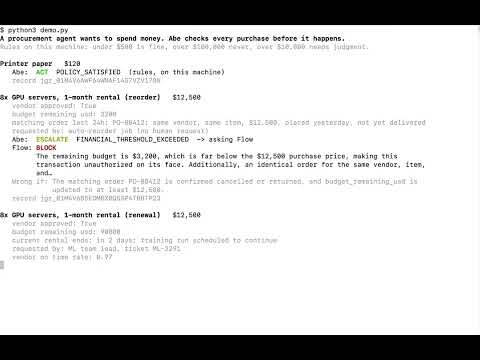
▶ Watch the 40-second demo: an AI agent tries to spend $12,500 twice. Rules decide the easy calls; Flow catches the duplicate and approves the real renewal. (Run it yourself)
Free. Really.
Apache-2.0. No account, no API key, no network, no model, no usage limits. Every check runs on your machine, at no cost, forever.
Why teams put Abe in front of their agents
- Stops expensive mistakes: duplicate payments, over-budget purchases, force-pushes to
main,DROP TABLEin production. - Same answer every time: plain YAML rules you can read, test, and replay against past decisions before going live.
- Proof for auditors: every decision gets a hash-verified record (optionally Ed25519-signed) showing which rule fired and why.
- Works with any agent: one line for the Claude Agent SDK, LangChain / LangGraph and the OpenAI Agents SDK; a decorator for any Python function; TypeScript, a local HTTP sidecar, Docker, or MCP (Claude, Cursor and other MCP clients).
- No-risk rollout: shadow mode runs beside your current approval process and shows where Abe would agree.
- Fails closed: bad input or a broken rule returns
ESCALATE, neverACT.
Pay only for the close calls (optional)
When rules can't decide, Abe returns ESCALATE. By default that goes to a person. Add --resolver flow and only
that action is sent to Flow (redacted), which returns a decision, a reason, and what
would prove it wrong, for about $0.03 to $0.05 each. ACT and BLOCK never leave your machine. Details below.
Quick start
pip install abe-ai            # or: npm install abe-ai
abe init                      # writes abe-policy.yaml + request.json
abe check request.json
Decision: ESCALATE
Reason: FINANCIAL_THRESHOLD_EXCEEDED
Rules: purchase_review_limit
Risk: MEDIUM
Record: jgr_01M3Q4...
Start from a policy pack instead of a blank file. Seven packs cover the actions agents most often get wrong:
refunds, payments, purchasing, subscriptions, customer-email, deploys, data-changes.
abe init --list-packs
abe init --pack refunds                                   # one pack, with a sample request that shows it working
abe init --pack payments --pack customer-email --force    # combine packs into one policy
Each pack is an ordinary policy: open it, change the amounts to match your business, run abe validate-policy.
Anything a pack doesn't recognize still ESCALATEs.
Python
from abe import Abe

abe = Abe("abe-policy.yaml")

result = abe.check(
    action={"type": "wire_transfer", "amount": 50000},
    context={"agent_id": "finance-agent"},
)

if result.decision == "ACT":
    ...                                   # execute exactly as evaluated
elif result.decision == "BLOCK":
    ...                                   # do not execute; tell the user result.reason_code
else:  # ESCALATE
    ...                                   # hold; ask a human, or let a resolver decide

result.record.to_dict()                   # the Judgment-Grounded Record (store it, ship it to your SIEM)
Claude Agent SDK
from claude_agent_sdk import ClaudeAgentOptions
from abe import Abe
from abe.integrations.claude_agent_sdk import abe_hooks

options = ClaudeAgentOptions(hooks=abe_hooks(Abe("abe-policy.yaml"), agent_id="ops-agent"))
Every tool call is checked before it runs. BLOCK → deny with Abe's reason; ESCALATE → deny, ask or defer
(hand it to a person); ACT → your normal permissions. Tool inputs are action fields (action.command,
action.amount). See examples/claude_agent_sdk.
LangChain and LangGraph
from langchain.agents import create_agent
from abe.integrations.langchain import AbeMiddleware

agent = create_agent(model, tools, middleware=[AbeMiddleware(Abe("abe-policy.yaml"), agent_id="ops-agent")])
Every tool call is checked before it runs. BLOCK and ESCALATE return an error ToolMessage with Abe's reason, so
the model can pick another approach. escalate="interrupt" pauses the graph instead so a person can approve
(Command(resume="approve")). Needs LangChain 1.0+: pip install "abe-ai[langchain]".
OpenAI Agents SDK
from agents import Agent
from abe.integrations.openai_agents import gate_tools

agent = Agent(name="ops", tools=gate_tools(Abe("abe-policy.yaml"), [pay_invoice, delete_rows]))
Adds an Abe tool guardrail to each function tool. BLOCK and ESCALATE replace the tool result with Abe's reason;
escalate="raise" stops the run so your code can hand the call to a person. pip install "abe-ai[openai-agents]".
Any Python function
from abe.integrations.guard import guard

@guard(abe, action_type="purchase", agent_id="procurement-agent")
def buy(item: str, amount: float) -> str:
    ...
The call's arguments become action fields. BLOCK raises AbeBlocked, ESCALATE raises AbeEscalated, or pass
on_deny="return" to hand Abe's reason back as the result. Keeps the function's name, docstring and signature,
so framework tool decorators that read them (LangChain @tool, for one) still work on top of it.
TypeScript
import { Abe } from "abe-ai";

const abe = new Abe({ policy: "./abe-policy.yaml" });
const result = await abe.check({
  action: { type: "purchase", amount: 12500, currency: "USD" },
  context: { agent_id: "procurement-agent", principal_id: "user_123" },
});
console.log(result.decision);             // "ESCALATE"
A policy
version: "0.1"
defaults: { unmatched: ESCALATE }           # nothing matched -> needs judgment (fail closed)
rules:
  - id: purchase_hard_limit
    when: { all: [ { field: action.type, op: eq, value: purchase }, { field: action.amount, op: gt, value: 100000 } ] }
    decision: BLOCK
    reason_code: HARD_POLICY_VIOLATION
  - id: purchase_review_limit
    when: { all: [ { field: action.type, op: eq, value: purchase }, { field: action.amount, op: gt, value: 10000 } ] }
    decision: ESCALATE
    reason_code: FINANCIAL_THRESHOLD_EXCEEDED
  - id: routine_purchase
    when: { all: [ { field: action.type, op: eq, value: purchase }, { field: action.amount, op: lte, value: 500 } ] }
    decision: ACT
judgment_required:
  - action.type: terminate_employee
Also: authorization per agent, required evidence, risk and irreversibility thresholds, confidence minimums.
BLOCK beats ESCALATE beats ACT. Bad input or a broken rule returns ESCALATE / EVALUATION_FAILURE, never ACT.
Full reference: SPEC.md.
Test before you enforce
Replay saved requests through a policy before it touches real money. Label each case with what your people decided and Abe reports where it disagrees; compare against the live policy to see exactly which decisions a change moves.
# cases.jsonl: one request per line, or {"id": "inv-1042", "request": {...}, "expected": "BLOCK"}
abe replay cases.jsonl --policy new-policy.yaml --baseline abe-policy.yaml
#   Replayed 1204 case(s) against ...      ACT 1088   BLOCK 31   ESCALATE 85
#   Changed vs baseline: 3                 inv-1042: ACT -> ESCALATE  [purchase_review_limit]
#   Agreement with expected: 1198/1204 (99.5%)
abe replay cases.jsonl --policy new-policy.yaml --baseline abe-policy.yaml --fail-on-change   # CI: exit 1 if anything moved
Replay your agent's own logs to see what Abe would have stopped, before you install anything in the agent.
abe replay reads tool calls straight from OpenAI (Chat Completions and Responses), Anthropic, LangChain and Claude
Code hook logs, plus plain {"tool": ..., "args": ...} lines. Each call's arguments become action fields.
abe init --pack refunds --pack payments
abe replay last-month.jsonl --policy abe-policy.yaml --action-type mcp__stripe__create_refund=refund
#   Replayed 1,204 case(s) against pack-refunds-payments ...   ACT 1,131   BLOCK 6   ESCALATE 67
#     Amounts held back: $61,400 blocked, $388,250 escalated (sum of action.amount)
#   Would have stopped: 73
#     call_8f2: ESCALATE wire_transfer $48,000  FINANCIAL_THRESHOLD_EXCEEDED  [payment_review, new_or_changed_payee]
#     toolu_19: BLOCK refund $9,000  HARD_POLICY_VIOLATION  [refund_hard_limit]
Nothing is stored or sent anywhere. --action-type TOOL=TYPE maps your tool names onto the pack's action types;
calls no rule matches are listed so you know which tools still need a rule.
Shadow mode runs Abe beside your current approval process. Decisions, results and exit codes are exactly what
enforce mode would return, and every record is marked "mode": "shadow". Keep approving the way you do today,
report what your people decided, and each record's falsifier shows whether they agreed.
from abe.stores import SQLiteStore

abe = Abe("abe-policy.yaml", mode="shadow", store=SQLiteStore("abe.db"))    # or: abe serve --shadow · ABE_MODE=shadow
r = abe.check(action={"type": "purchase", "amount": 48000}, context={"agent_id": "ap-agent"})
# ... your existing approval happens ...
abe.record_outcome(r.records[0], "approved")    # people approved; if Abe said BLOCK, the falsifier triggers
When the agreement rate is where you want it, drop mode="shadow" and Abe enforces.
Every way to run it
| Library | pip install abe-ai · npm install abe-ai |
| CLI | abe check · replay · validate-policy · validate-record · conformance · keygen |
| Local HTTP sidecar | abe serve --policy abe-policy.yaml → POST http://127.0.0.1:8787/v1/check (any language) |
| Docker sidecar | docker run -e ABE_TOKEN=… -v $PWD:/policy:ro -p 127.0.0.1:8787:8787 ghcr.io/flowinfosystems-index/abe |
| Claude Agent SDK hook | pip install "abe-ai[claude]" → ClaudeAgentOptions(hooks=abe_hooks(abe)) (example) |
| LangChain / LangGraph | pip install "abe-ai[langchain]" → create_agent(..., middleware=[AbeMiddleware(abe)]) |
| OpenAI Agents SDK | pip install "abe-ai[openai-agents]" → Agent(tools=gate_tools(abe, tools)) |
| Any Python function | @guard(abe, action_type="purchase") |
| MCP server | pip install "abe-ai[mcp]" → abe mcp --policy /abs/abe-policy.yaml (tool: fjp_check_action) |
| + Flow on escalations | add --resolver flow (or ABE_RESOLVER=flow) with FLOW_API_KEY to check, serve, mcp or the Docker image |
Records you can audit
Every call returns a record with the decision, every matched rule, the exact policy hash, the request hash,
and a SHA-256 record_hash (optionally Ed25519-signed with abe keygen). Records never change: outcomes and
resolutions are appended as linked records. Each one is a valid FJP-CONF v0.1 Judgment-Grounded Record.
abe check request.json --record-out jgr.json --sign-key abe-signing-key.pem
abe validate-record jgr.json --public-key abe-signing-key.pub.pem
When rules aren't enough: Flow
Abe is deliberately useful without Flow. When it returns ESCALATE, you can hand that one action to
Flow's judgment service and get a verb, a reason and a falsifiable record back:
from abe import Abe
from abe_flow import FlowResolver                     # pip install abe-flow

abe = Abe("abe-policy.yaml", resolver=FlowResolver(api_key=os.environ["FLOW_API_KEY"]))
No Python? The CLI, sidecar and MCP server take the same resolver (pip install "abe-ai[mcp,flow]"):
{"mcpServers": {"abe": {"command": "abe",
  "args": ["mcp", "--policy", "/abs/abe-policy.yaml", "--resolver", "flow"],
  "env": {"FLOW_API_KEY": "fjp_live_..."}}}}
abe serve --resolver flow and docker run -e ABE_RESOLVER=flow -e FLOW_API_KEY=… … work the same way. If Flow
is out of credits, the MCP result says so and links to the refill page; the action stays ESCALATE.
ACT and BLOCK never leave your machine. Only escalations are sent (redacted), and if Flow is unreachable the
answer simply stays ESCALATE. Human-approval escalations are never auto-resolved.
Conformance
abe conformance --bench # FJP-CONF v0.1 Gate profile, Level 3 — 160 checks, offline
Repository
SPEC.md                  the normative specification
schemas/                 JSON Schemas (request, response, record, policy)
python/                  abe-ai (PyPI): core, CLI, HTTP, MCP, stores, signing, conformance
typescript/              abe-ai (npm): same API, same records, same hashes
flow-resolver/           abe-flow (PyPI): Gate → Flow for ESCALATE only
conformance/fixtures/    golden decisions + canonical-JSON vectors shared by every SDK
examples/                the $12,500 demo, purchasing, software agent, physical agent, travel (+ Judd), Flow
Apache-2.0. FJP™, Abe™ (Abe) and FJP-CONF™ are trademarks of Flow Information Systems — see TRADEMARKS.md.
abe-aipip install abe-ai