
backfold
io.github.pgg898200-ship-it/backfold
Summarize local time-series CSVs, inspect time windows, smooth signals and compare channels.
Documentation

Backfold
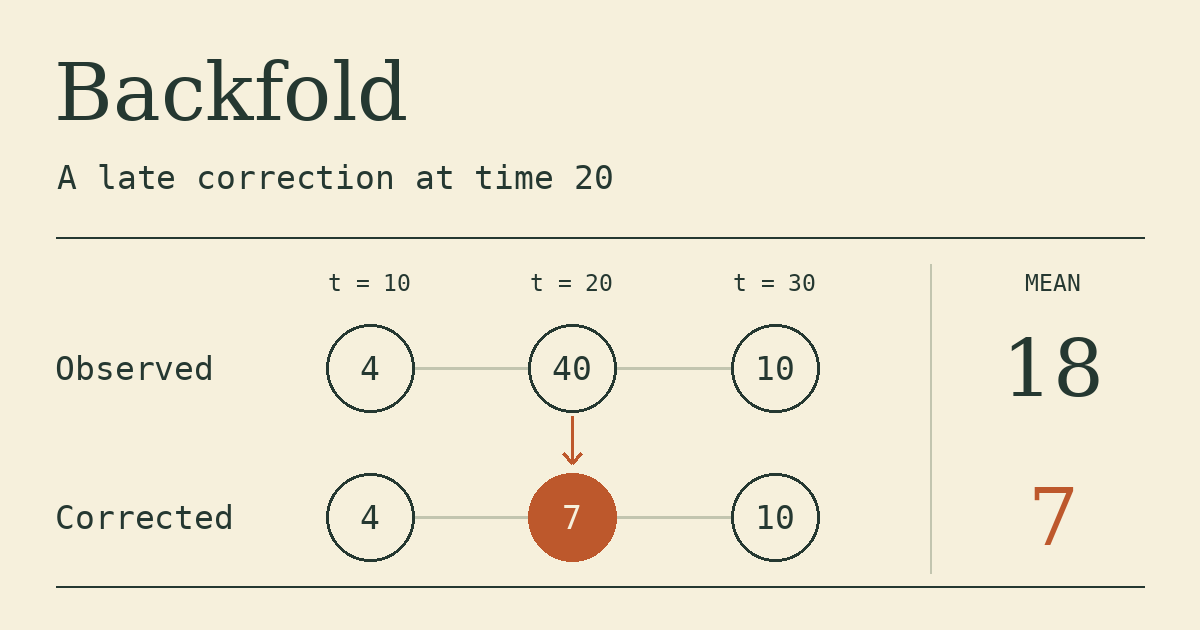
Update a time-series statistic when an old reading changes. Backfold is a Rust library with Python bindings. Feed it timestamped observations from your event consumer. When a sensor sends a correction, Backfold updates the affected summaries so your dashboard, model or alert can read the revised answer.
Try a late edit in your browser · Install the Python package · Agent guide
Correct one reading in Python
Install with python -m pip install backfold. A fork shares the original history until you edit it.
from backfold import MomentsStream

observed = MomentsStream()
for t, value in [(10, 4.0), (20, 40.0), (30, 10.0)]:
    observed.upsert(t, value)

corrected = observed.fork()
corrected.upsert(20, 7.0)
print(observed.summary()["mean"], corrected.summary()["mean"])
# 18.0 7.0
Use upsert on the original stream to accept the correction directly. Use retract to remove a reading. An event key consists of event time, source ID and sequence number. The example uses the default source ID and sequence number, so a second write at time 20 replaces the first.
Where it fits
Embed Backfold in the process that consumes events. Each supported operator keeps a tree of summaries in event-time order. With the operator and dimension fixed, a single edit touches O(log T) nodes for T events. The tree also supports historical range queries and O(1) forks. Your application owns ingestion and durable storage.
| Need | Start here |
|---|---|
| Recompute the mean, variance or extrema after a correction | MomentsStream |
| Smooth irregularly spaced measurements or revise an alarm time | EwmaStream, CusumStream.first_alarm |
| Revise the estimated trajectory after a late observation | Kalman filtering and RTS smoothing |
| Inspect covariance, correlation, principal components or multivariate outliers | Covariance and Mahalanobis scoring |
| Update a regression when a delayed label arrives | RidgeStream |
| Reconstruct what was known at an earlier time or screen many channels for alarms | Bitemporal queries and e-value screening |
A sequential pass has a lower initial cost for a one-off append-only aggregate. Dense covariance and ridge summaries grow quadratically with feature dimension. The architecture notes describe the operator costs and numerical assumptions. Architecture
Give an agent a CSV
The native CLI can summarize a local CSV into timestamped windows and drill back into the original file for raw rows. From a clone of this repository with Rust and Cargo installed, run the following commands.
cargo build --release --bin backfold
./target/release/backfold digest benchmarks/sample_100k.csv
./target/release/backfold drill benchmarks/sample_100k.csv --start 22498 --end 22507
For a desktop client that opens MCP bundles, install the Backfold 0.3.0 bundle. The package supports Apple Silicon macOS, Windows x86-64 and Linux x86-64. Official MCP Registry entry · Try it on a four-row CSV
To connect Claude Code, run these commands from the same checkout after building the binary. The local scope keeps the setting private to this project. If you downloaded a prebuilt executable, use its absolute path in the first command.
claude mcp add --transport stdio --scope local backfold -- "$PWD/target/release/backfold" mcp
claude mcp get backfold
A successful check reports Connected. Try asking Claude to inspect timestamps 1 through 2 in the four-row CSV with backfold_drill_csv. The observations are 25 and 42.
For manual MCP configuration, set the command to the absolute path of that executable and the arguments to ["mcp"]. The server uses standard input and output. Start with backfold_digest_csv for a summary and backfold_drill_csv for the underlying rows. The reference includes the tools for Kalman smoothing, covariance and channel screening. Agent guide · API reference · Coding-agent skill
What does a late edit cost?
At 100,000 readings, the recorded Python moments benchmark took 6.06 µs median to replace one reading, read the summary and restore the old reading. Recomputing the moments over the edited array took 273 µs in Polars and 730 µs in NumPy. The largest absolute difference across mean, variance, skewness and excess kurtosis was 4.55 × 10⁻¹⁶ (rounded up). These are warm, in-memory timings on the recorded Linux x86-64 run. They exclude initial tree construction and I/O.
The results also include native Rust baselines, range queries, a 64-fork workload and CSV digest evaluation. Run ./target/release/backfold bench for native timings on your machine. Benchmark method · Recorded results (JSON) · Sequential reference implementations
Source license · CI · Compare related tools · PGG engineering tool directory
https://github.com/pgg898200-ship-it/backfold/releases/download/v0.3.0/backfold-0.3.0.mcpb# mcpb: https://github.com/pgg898200-ship-it/backfold/releases/download/v0.3.0/backfold-0.3.0.mcpb